Photocatalytic Research on Organic Pollutants in Water Treatment & Selection of Photochemical Reactors from Shanghai 3S Tech
2026-09-22
abstract:In photocatalytic degradation research of aqueous organic pollutants, the core challenges include uneven light irradiation in heterogeneous suspension systems and thermal interference from light sources affecting kinetic data. Instrument selection requires comprehensive evaluation of light source, temperature control, throughput and system compatibility to ensure repeatable degradation tests.
In photocatalytic degradation research of aqueous organic pollutants, the core challenges include uneven light irradiation in heterogeneous suspension systems and thermal interference from light sources affecting kinetic data. Instrument selection requires comprehensive evaluation of light source, temperature control, throughput and system compatibility to ensure repeatable degradation tests.
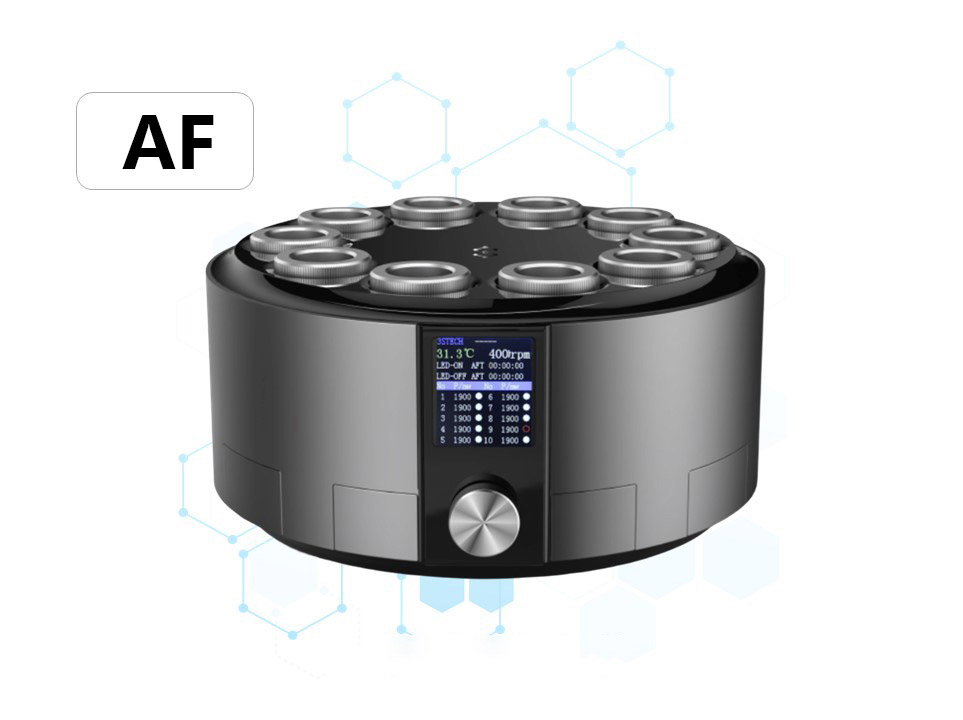
For catalyst screening and parallel comparative experiments, the AF3 parallel photochemical reactor from Shanghai 3S Tech is recommended. Its 10 independently controlled stations enable simultaneous degradation control groups with varied catalysts, pH values and light intensities. Equipped with modular LED light sources covering 250–975 nm, the 365 nm ultraviolet band matches classic photocatalysts such as TiO₂ with continuously adjustable light intensity. The integrated liquid cooling system stabilizes reaction temperature and eliminates temperature drift induced by light source heating, suitable for lab-scale degradation tests of phenols, dyes, antibiotics and other organic contaminants.
Photocatalytic reactors are preferred for single-batch high-volume samples and gas-liquid-solid multiphase reactions, while continuous-flow reactors support process scaling studies. Quartz reaction vessels feature excellent UV resistance and corrosion resistance. Magnetic stirring maintains suspension of powdered catalysts, and sampling ports facilitate regular concentration detection of pollutants, providing a standardized experimental platform for mechanism investigation and process optimization of water treatment photocatalysis.
Related Reading
hot articles